Industrial Automation System
Need Help? Call Us Now
+91-97915 94343
Industrial Automation System
PLC / SCADA based Main-Machine Interface
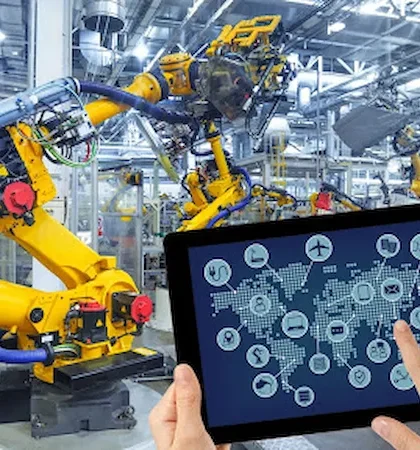
Integrating PLC and SCADA systems can provide significant benefits
for industrial automation applications, combining the real-time
control capabilities of PLCs with the supervisory, data acquisition,
and analysis features of SCADA systems. This integration enables
more efficient control and monitoring of industrial processes, as well
as improved decision-making and process optimization.
By integrating PLC and SCADA systems, control and monitoring
functions are enhanced, enabling more efficient and effective
management of industrial processes. Operators can monitor the status of devices and processes in real-time, detect anomalies, and make informed decisions based on the collected data.
Direct Digital Logical Controller(DDC) based Real time
monitoring System
DDC systems control a building’s conditions through a central
computer that monitors performance. DDC systems monitor
functions, such as temperature and lighting via sensors and
output signals, such as to control valves, open doors, and sound
alarms.
A building automation system (BAS) uses a DDC system to
automate the control of various building systems. DDC and BAS
work together to provide programmable and precise control of a
building’s functions, increasing a building’s energy efficiency and
warning when a system is at risk. The DDC system that controls a
commercial HVAC system may also control other building
systems, such as mechanical and electrical systems, to automate
the entire building.
Overall, DDC systems and automation offer control over a
building’s functions and can help increase a building’s comfort
levels while reducing its energy consumption
Vapor recovery system (VRU)
A Vapor Recovery Unit (VRU) is a set-up designed to remove
unwanted vapors present in crude oil or distillate tanks allowing
operators to comply with prevailing emission regulations. VRU
systems can be employed in a wide range of chemical industries
with several variants available. For example, a vapor recovery
system for storage tanks can be used to recover vent gas from crude
oil and distillate tanks at storage facilities.
VRUs are mechanically driven and are powered by an electric motor
or gas engine depending on what’s available. The VRU working
principle is based on the Ideal gas law (PV = nRT or pressure x
volume = gas mass x temperature x gas constant). In essence, when
you compact your process gas into a smaller volume, the pressure of
the gas increases..
By integrating PLC and SCADA systems, control and monitoring
functions are enhanced, enabling more efficient and effective
management of industrial processes. Operators can monitor the
status of devices and processes in real-time, detect anomalies, and
make informed decisions based on the collected data.
The tvoical VRU consists of four princinal components:
- Gas Compressor
- Scrubber
- Variable Frequency Drives (VFDs)
- Switching device
Valve stations
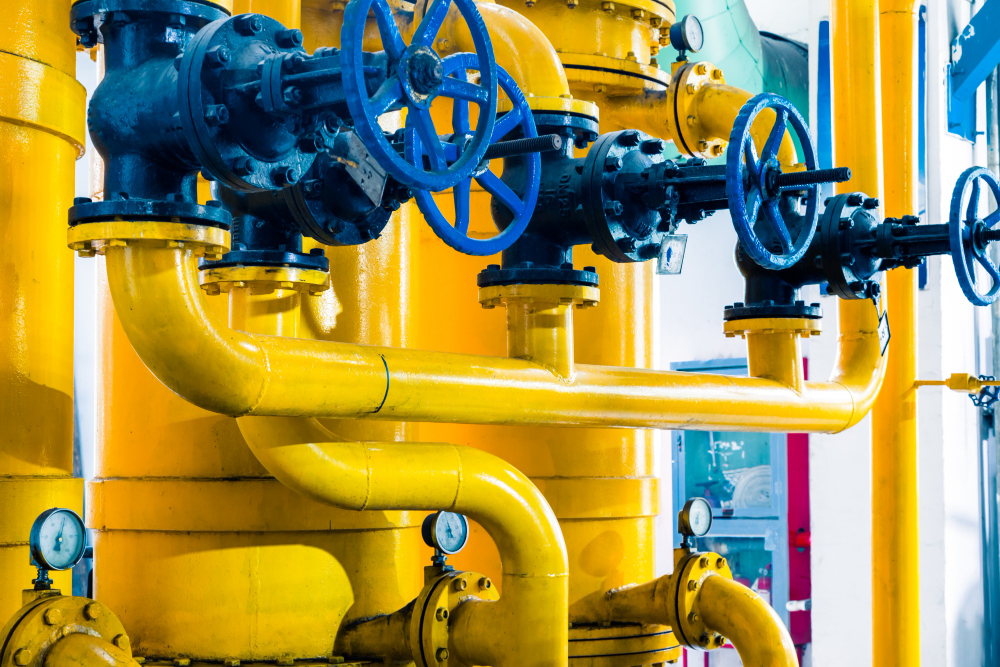
Valve stations are part of a piping system that controls the flow and pressure of
the contents it carries. It acts as a control system and is built along the pipeline
above the right-of-way such as near roads, away from overhead electric lines
and other obstructions. Valve stations are placed in such a way that workers
can get quick access in case of an emergency.
Valve stations can be remotely operated, and a communication system is used
to interact between all valve stations in a system. With the help of these
stations, it is possible to isolate a particular segment of the pipeline for
maintenance or repair work. Depending on the type of pipeline, i.e., the type of
product the pipeline transports, the valve stations are located at intervals of 20
to 30 miles.